

Schedule a Measure
Enhancing the accuracy of quotes and eliminating unnecessary guesswork
BALANCED TEAM: Project manager, UX Designer, Engineering
MY ROLES: Lead UX Designer, User Research
TOOLS: Figma, Miro, Co-Pilot
TIME: 2 Months

The problem
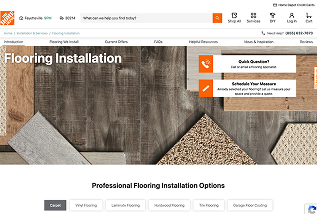
The scheduling process suffers from a lack of transparency and high drop-off rates. Customers are often asked to pay a fee upfront without a clear understanding of who will be coming into their home, when the technician will arrive, or what the final quote will be.
Key challenges
After paying, customers often face a "silence period". They've committed funds but can't schedule the service until a third-party technician calls them.
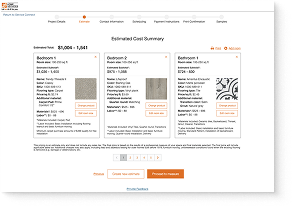
Users often use the online project calculator to get a rough idea. When the pro measures and adds stairs, transitions and subfloor, the quote creates sticker shock.
A customer measures for a specific flooring and changing the material can sometimes break the link to the original measure data.
The objective
To transform Home Depot’s Schedule a Measure service from a fragmented, manual hurdle into a high-conversion digital tool for professional installations. The project aimed to eliminate miscommunications between customers, store associates, and contractors.
Research and discovery
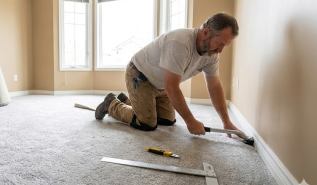
My discovery phase for the Schedule a Measure tool centered on the trust gap, the high-friction moment where a customer hands over money for a service they haven't fully visualized. I conducted a series of contextual inquiries, shadowing Flooring Specialists on the showroom floor and riding along with third-party technicians. I discovered that while the happy path looked clean on paper, the reality was a fragmented ecosystem of legacy software and manual workarounds
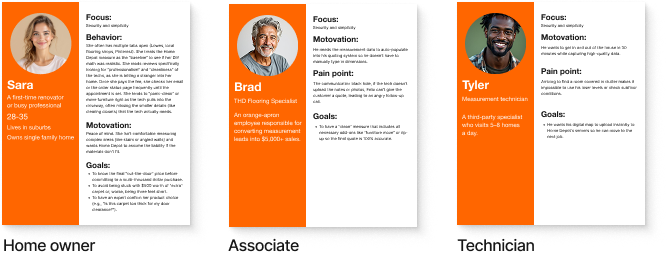
Personas
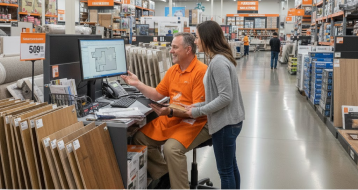
Contextual inquiries
These inquiries (3) provided insights into the data blindspots and order fragmentation of the previous legacy system. A customer’s measurements reside in one system while SKUs reside in another. It also highlighted the inability to know where in the process the customer’s order is.
Competitive analysis
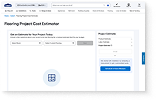
Lowes
Lowe’s frequently offers Free In-Home Measurements as a standard promotion to lower the barrier to entry.

Floor & Decor
They do not manage the installation in-house but provide a pro network of independent installers.

Menards
Relies heavily on DIY Tools rather than scheduling a measure as an entry point.
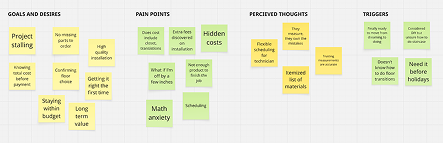
Affinity mapping
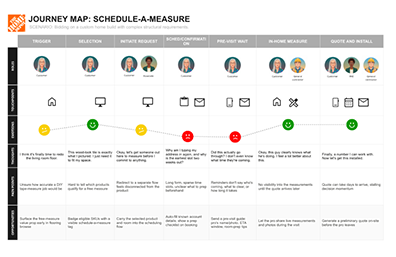
Journey map
My design process
My process followed a Double Diamond framework, tailored to the challenges of a customer, associate, and technician. I focused on moving away from designing for a screen to designing for a service ecosystem.

I collaborate with PM to define the problem space, not the solution and a clear understanding of the success metrics.

I create user flows and logic maps. Review these flows with PM to ensure edge cases
are accounted for.

I always insist on starting in grayscale. If a design doesn't work in black and white with basic boxes, color and shadows won't save it.

I bring these to the UX team for design critique. This is where we check for consistency with our existing Design System and gather feedback.

I create high-fidelity clickable prototypes and share them with partners and stakeholders to gather feedback and refine.

User test! User test! User test! There is no getting around it. Synthesize feedback, share with stakeholders and make necessary updates.

I finally hand off a deeply vetted prototype to engineering and along with documentation.
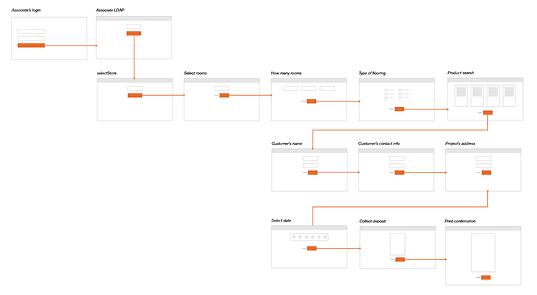
User flow
Created a research plan
7 monitored interviews of flooring specialists
Synthesized interviews
Presented findings to partners/stakeholders

User interviews
My final design
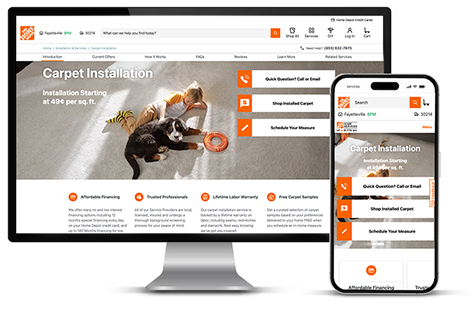
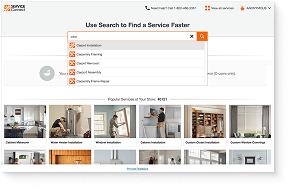
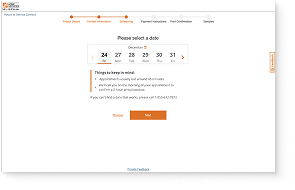
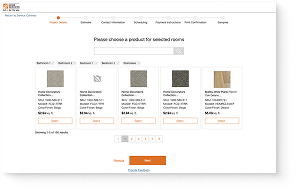
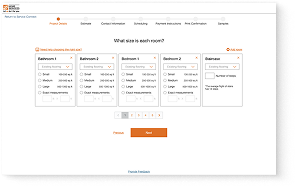
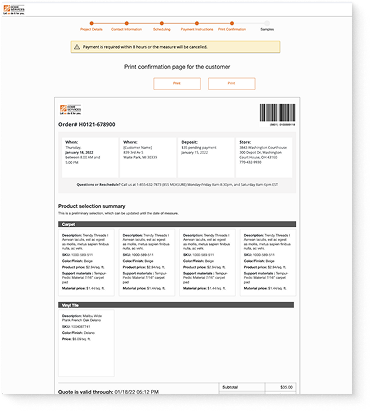
I bridged the gap between digital tools and in-home service by treating the measure as a milestone rather than a transaction.
I use clear UI to eliminate communication gaps, reduce friction and keep users informed.

The results
My final design transformed a fragmented, opaque process into a unified tool that serves as a single source of truth for the homeowner, the store associate, and the technician. This ecosystem-wide approach designs a seamless transition from a customer’s home visit to a digital purchase, reducing anxiety for staff and building deep project confidence for the user.

70%
Reduction in time spent on manual paperwork
for associates
$145
Increase in average
order value
18%
Increase in lead-to-install conversion
“I used to hate telling a customer that someone would call them in a few days just to set the appointment. You could see them lose interest immediately. Now, I can turn my screen around, show them the calendar, and we lock in a date before they even leave. It makes me feel like a professional project manager instead of just someone taking a message.”
Associate’s feedback
“"It’s a total game-changer for the sticker shock conversation. In the past, customers thought we were just guessing at the numbers. It builds so much more trust right out of the gate.”
“My phone stays quiet. I can focus on closing big flooring deals instead of acting like a human status bar for dozens of different projects”.

Key learnings
The Schedule a Measure tool served as a lesson in proving that technical accuracy is only half the battle. The project's primary takeaway was that transparency is the ultimate friction-reducer through scheduling and data processing. We didn't just improve efficiency. A foundation of trust between the homeowner, the associate, and the technician was built. These learnings demonstrate that service stops being a barrier to entry and starts being a catalyst for sales conversion and customer loyalty.
What worked well
Moving from a manual callback to a real-time booking at checkout was the single biggest driver for conversion. Giving the customer a confirmed date immediately removed their anxiety and reduced lead abandonment
by 18%.Creating a UI view where the customer, associate, and technician all see the same data points. This eliminated miscommunication and ensured that the quote at the store perfectly matched expectations.
Empowering customers to toggle between different carpet SKUs or padding types within their quote allowed them to select their budget. This reduced the time associates spent reworking quotes.
Opportunities
Allow users to use their phone’s camera to do a scan of the room before booking a professional. The tool could identify stairs or complex corners and provide a more realistic price range.
Create a project feed where the Measure Tech can upload photos of subfloors or transitions directly to the order.